Small Space Home Office Ideas: 15 Brilliant Ways to Fix Awkward Corners
Small space home office ideas that actually work: smart layouts, clever storage, and corner fixes for tight rooms and odd nooks.
Not everyone gets a spare bedroom to turn into a home office. Most of us are working with a hallway nook, a slice of the living room, or that oddly shaped corner nobody knew what to do with. The good news is that a small space home office doesn’t have to feel cramped or make you dread sitting down to work. With the right layout, a few smart furniture choices, and some honest thinking about what you actually use during the day, even the trickiest corner can become a spot where you get real work done.
This guide walks through practical, tested ideas for setting up a home office in a small space, including awkward corners, closets, under-stair nooks, and shared rooms. You’ll find advice on furniture sizing, storage, lighting, and layout tricks that make a tiny footprint feel functional rather than squeezed. None of this requires a renovation or a big budget. It’s mostly about making better use of the square footage you already have and being deliberate about what earns a spot in your workspace. By the end, you should have a clear sense of which approach fits your room, your work style, and the corner you’ve been staring at, wondering if it could actually become something useful.
EXPLORE THE CONTENTS
1. Start by Measuring the Space Honestly
Before buying anything, grab a tape measure. A lot of small office plans fall apart because people guess at dimensions and end up with a desk that’s two inches too wide for the corner. Measure the width, depth, and height of the area, and note anything that eats into the space, like a radiator, an outlet, or a window that swings open.
- Measure wall-to-wall width and floor-to-ceiling height
- Note the swing radius of any doors nearby
- Mark where outlets and light switches sit
- Check for uneven walls or angled ceilings, common in awkward corners
This step sounds basic, but it’s the difference between a workspace that fits and one that feels like a compromise every single day.
2. Choose a Desk That Matches the Corner, Not the Trend
A corner desk is often the obvious answer for tight spaces, and for good reason. It tucks into a right angle and uses wall space that would otherwise sit empty. But corner desks aren’t the only option, and picking the wrong shape can waste more room than it saves.
- L-shaped desks work well in true corners but need at least 4 feet of clearance on each arm to avoid feeling boxed in
- Floating wall-mounted desks fold up or stay slim, ideal for hallways or closets
- Narrow console desks (16–20 inches deep) suit rooms where depth is the real constraint
- Corner-fit triangular desks make use of angled or oddly shaped nooks that standard rectangles can’t touch
If your corner is genuinely irregular, a custom-cut desktop on brackets is often cheaper than people expect and solves the problem permanently.
3. Turn a Closet Into a Micro Office
The “cloffice” trend exists for a reason. A closet gives you four walls, a door you can shut, and usually an outlet nearby. Removing the closet rod and shelving on one side opens up enough depth for a desk, and the door can either come off entirely or stay for when you want the mess out of sight.


How to set it up:
- Remove hanging rods and bulky shelving
- Install a slim desktop at standard desk height (28–30 inches)
- Add a power strip along the back wall before the desk goes in
- Use the upper closet shelf for a printer, files, or a small light fixture
- Keep the door on a track so it can close the office away visually when you’re done
This works particularly well for anyone doing video calls, since a closet office naturally has a clean, contained backdrop.
4. Make the Most of Under-Stair Space
The space under a staircase is one of the most underused areas in a house. It’s often left as storage for coats and vacuum cleaners, but with a bit of carpentry or a well-chosen piece of furniture, it can become a surprisingly functional home office in a small space.
The trick is working with the slope rather than fighting it. Put the desk at the tallest end, where you have full headroom, and use the lower, sloped section for filing drawers or low shelving where you don’t need to stand up straight. A built-in bench-style desk that follows the stair angle looks intentional rather than squeezed in, and it makes use of a footprint that would otherwise sit empty.
5. Go Vertical With Storage
When floor space is limited, the walls have to do more work. Vertical storage keeps your desktop clear without eating into the room.
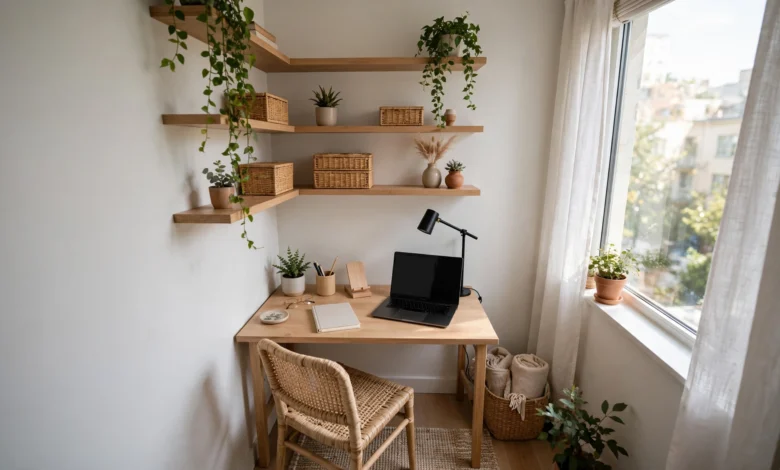
- Floating shelves above the desk for books, files, and decor
- Pegboards for stationery, cables, and small tools, easy to rearrange as needs change
- Wall-mounted filing systems instead of a floor cabinet
- Tall, narrow bookcases (12 inches deep or less) that fit beside a desk without blocking a walkway
Vertical storage also draws the eye upward, which makes a small room feel taller and less boxed in, a simple trick interior designers rely on constantly.
6. Use Multi-Functional Furniture
In a small space, every piece of furniture should earn its spot by doing more than one job. A multi-functional desk setup might include a drop-leaf table that folds flat against the wall when not in use, or an ottoman with hidden storage that doubles as extra seating for calls.
Some options worth considering:
- Fold-down wall desks (Murphy-style) that disappear completely when not needed
- Storage ottomans that hide cables, chargers, and paperwork
- Bookcases with a built-in desk slab
- Rolling carts that serve as a printer stand by day and a side table by night
This approach matters most in studio apartments or shared rooms, where the office needs to coexist with a bedroom, dining area, or living room without dominating it.
7. Get the Lighting Right
Poor lighting is one of the fastest ways to make a small office feel worse than it needs to. If your corner doesn’t get natural light, layer in artificial sources rather than relying on a single overhead fixture, which tends to create harsh shadows on a desk.
- A desk lamp with adjustable brightness for close work
- A wall sconce or floor lamp for ambient light that softens shadows
- Daylight-balanced bulbs (around 5000K) if you’re working without windows
- Task lighting angled to avoid screen glare
Natural light also plays a bigger role in daily energy and focus than most people realize. The National Sleep Foundation notes that exposure to natural or bright light during the day helps regulate alertness, which is worth keeping in mind if your desk is tucked into a windowless corner. If you can position the desk near even a small window, do it. If not, a daylight lamp is a reasonable substitute.
8. Set Up the Desk for Real Ergonomics, Even in a Tight Spot
It’s tempting to sacrifice comfort for space, but a cramped setup that hurts your back or wrists isn’t actually saving you anything. Even in a small footprint, you can hit the basics of good ergonomics.
- Keep the monitor or laptop screen at eye level, using a stand or stack of books if needed
- Choose a chair that supports your lower back, even if it’s a compact model
- Keep your feet flat on the floor or on a small footrest
- Leave at least 20 inches of desk depth for keyboard and mouse movement
The Occupational Safety and Health Administration publishes detailed guidance on setting up a workstation that reduces strain, and it’s worth a quick read even for a small home setup. You can check their computer workstation ergonomics guidelines for specifics on chair height, monitor distance, and posture.
9. Paint and Color Choices That Open Up the Room
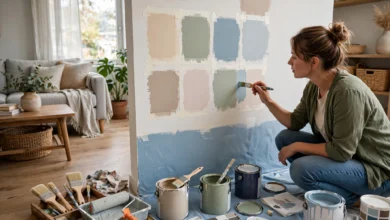
Color has a real effect on how spacious a room feels, and it costs a lot less than moving walls. Light, cool tones like soft white, pale gray, or light sage tend to make a small corner feel airier. If you want more personality, painting just the back wall of the nook in a deeper color, while keeping the surrounding walls light, can create a defined “office zone” without shrinking the room visually.
Mirrors help too. A mirror positioned to reflect a window or light source can make a windowless corner feel noticeably brighter and less closed in.
10. Keep Cables and Tech Under Control
Nothing makes a small office look chaotic faster than a tangle of cords. In a bigger room, cable clutter can hide behind furniture. In a small one, it’s usually right in view.
- Use a cable tray mounted under the desk to bundle cords out of sight
- Velcro ties instead of zip ties, so you can adjust as your setup changes
- A single power strip with USB ports to cut down on adapter clutter
- Wireless keyboard and mouse to reduce the number of cords on the desktop itself
This is a small detail, but in tight quarters, it has an outsized effect on how organized the whole space feels.
11. Personalize Without Cluttering
A small office still needs to feel like your space, not just a functional box. The key is being selective. Pick one or two meaningful items, a plant, a piece of art, a framed photo, rather than covering every surface. A single trailing plant on a shelf or a small piece of wall art above the desk adds warmth without competing for the limited space you have.
- One statement item per shelf or wall section
- A small plant for texture and a bit of life (low-light varieties like pothos work well in dim corners)
- A cork or magnetic board instead of loose papers pinned everywhere
- Rotate decor seasonally instead of adding more permanently
12. Awkward Corners: Specific Fixes
Some corners are genuinely odd shapes, angled ceilings, a nook beside a chimney breast, or a sliver of space between a window and a wall. These need a slightly different approach than a standard square room.
- Angled ceiling corners: Position the desk where the ceiling is tallest, and use the lower area for storage bins rather than anything you need to reach standing up
- Narrow slivers (under 3 feet wide): A wall-mounted fold-down desk is usually the only realistic fit
- Chimney breast alcoves: Custom shelving on either side with a desk in the recessed middle uses the architecture rather than fighting it
- Bay window corners: A curved or custom-cut desktop that follows the window line makes use of natural light and an otherwise wasted shape
Awkward doesn’t mean unusable. It usually just means a standard rectangular desk isn’t the right tool for that particular footprint.
13. Room Dividers for Shared Spaces
If your office corner sits inside a bedroom or living room, a visual boundary helps you mentally switch into work mode and keeps the rest of the room feeling separate. This doesn’t require a full wall.
- A slim bookcase turned perpendicular to the wall
- A curtain on a ceiling track for a soft, low-cost divider
- A folding screen that tucks away when not needed
- An open shelving unit that divides space without blocking light
14. Keep a Weekly Reset Routine
A small office shows mess faster than a large one. Ten minutes at the end of the week to clear the desk, file loose papers, and put decor back in place keeps the space feeling functional instead of overwhelming. This matters more in compact setups because there’s no extra surface to shove clutter onto out of sight.
15. Test the Layout Before Committing
Before buying furniture, tape out the desk dimensions on the floor with painter’s tape and walk through your typical day. Sit where the chair would go, reach for where shelves might sit, check if a door or drawer would hit a wall. This costs nothing and catches problems that are much more annoying to fix after furniture is assembled and bolted to a wall.
Conclusion
A small footprint doesn’t have to mean a frustrating workspace. Whether you’re working with a closet, an under-stair nook, or a genuinely odd-shaped corner, the same principles apply: measure honestly, choose furniture that matches the actual shape of the space, push storage upward instead of outward, and don’t skip lighting or ergonomics just because the room is tight. A home office for small spaces succeeds not by cramming in more, but by being deliberate about what earns a place in it. Get those basics right, and even the most awkward corner of your home can become the spot where your best work happens.